Loading, please wait…
Café Cup Buyer's Guide
Understanding takeaway cups for your café
Cup construction, coating types, print methods, and ordering patterns explained in plain language. Build confidence through information before you buy.
For cafés, takeaway counters, and foodservice operators in Ireland
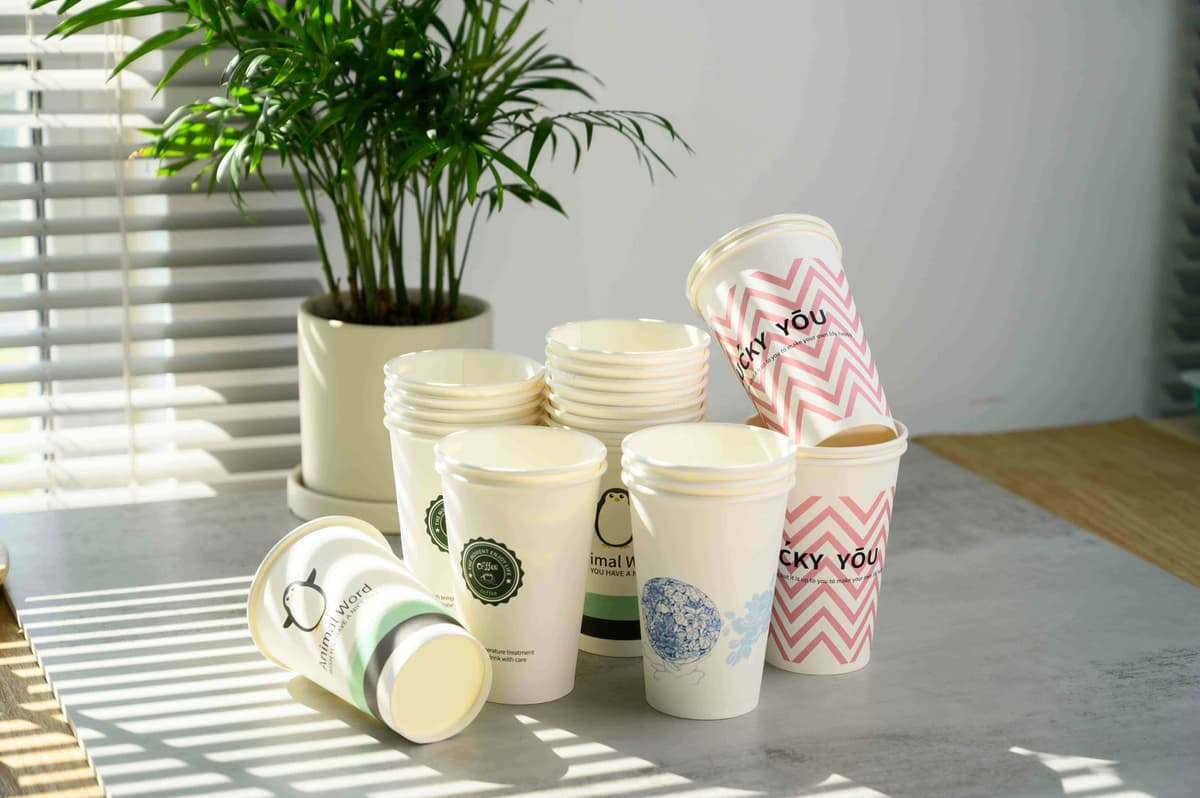
Common takeaway formats
8 oz (240ml), 12 oz (360ml), and 16 oz (480ml) are the most common sizes across Irish cafés.
In this guide
Step 1 · Cup constructions
Single wall and double wall options
Choose based on drink temperature, whether you want to avoid sleeves, and how important print/branding is. Below is the practical view we give new cafés in Ireland.

One layer of paper (PE/PLA/aqueous lined). Perfect for cold drinks and lower-temp service. For hotter drinks (50–55°C+) you’ll usually need a sleeve.
When to use
- •50%+ cold/iced drinks
- •Lowest per-unit cost
- •Okay with sleeves

Once you’ve decided between single and double wall, the next choice is which lining or coating actually makes sense for your waste streams. That’s where Step 2 comes in.
Step 2 · Coating & materials
PE, PLA or Aqueous? What’s actually practical?
Every cup needs a moisture barrier. The sensible choice is the one that matches your waste contractor, the sustainability story you want to tell, and your cup budget, in that order.
Most common
PE lined (polyethylene)
A thin PE film bonded to the paper. This is what most Irish cafés use today — proven, good heat resistance, and lowest unit price.
Best for
General waste collections and operators who just want stock to land every week.
Key point: recycling normally needs specialist processing, so plan for general waste.
Industrial Compostable
PLA lined (plant-based)
Bio-based lining that can break down in industrial composters (55–60°C). The catch is that not every Irish site has that stream available.
Best for
Cafés, corporates or campuses already paying for compostable waste collection.
Key point: typically 10–20% above PE. If it still goes to general waste, the benefit is mostly communication.
Home Compostable
Aqueous coating
Uses a water-based dispersion instead of a plastic film. That makes the end-of-life conversation simpler, especially when the cup carries recognised certifications.
Best for
Cafés that want a cleaner “plastic-free lining” message. Does not require EU Single Use Plastic label.
Key point: Can carry DIN Home Compostable, Flustix Recyclable or PAP 21 certifications.
How to decide quickly
Ask your waste provider what they actually accept. If it's general waste, use PE. If they support compostable, PLA is fine. If they support paper/cardboard with certified cups, aqueous gives you the cleanest story. We can quote all three.
Step 3 · Cup sizes
Understanding cup sizes for your café
Most Irish cafés rely on three core sizes: 8, 12, and 16 oz. We can also supply 4, 10 and 20 oz — we just flag them as lower-volume so you don’t tie up storage.
8
8 oz (240ml)
Small size
Cortados, flat whites, small Americanos, espresso-forward drinks. Good if your menu has a specialty tilt.
Typical usage
10–25% of volume
Most common
12
12 oz (360ml)
Standard size
Lattes, cappuccinos, Americanos — this is the cup most Irish cafés run through fastest. Anchor your ordering here.
Typical usage
50–60% of volume
16
16 oz (480ml)
Large size
Large lattes, iced drinks, smoothies, loaded hot chocolate. Demand goes up in summer.
Typical usage
20–30% of volume (seasonal)
Prestopak view: anchor, then flex
Lead with 12 oz, support with 8 and 16 oz, and only surface specialty sizes when the menu justifies it. That keeps storage tidy, cash in the business, and ordering simple.
Checkpoint · Avoid these pitfalls
Common mistakes when buying cups
These show up again and again with new cafés and operators changing supplier. If you avoid these, your cup programme will feel a lot calmer.
Ordering custom print too early
You don’t know your real size mix until you’ve traded 2–3 months. A 10,000-cup flexo run before that can leave you overstocked on 8 oz and short on 12 oz. Start on stock, track, then customise.
Choosing coating based on marketing only
PLA or “compostable” sounds better, but if your waste still goes to general, you’ve just paid more for the same outcome. Match coating to the waste route first.
Underestimating storage needs
A proper printed run is bulky, often 10 cases per size. If space is tight, plan split deliveries by stocking with us or stay on standard cups until you have space.
Not allowing for artwork time
Lead time starts at artwork approval, not when you say “go.” If your artwork is not 100% print ready, add 1–2 weeks for designer back-and-forth on top of factory lead time.
Ignoring lid compatibility
Rims vary slightly by manufacturer. Your 80mm lids may not fit your new 10oz cup. Test with your legacy lids before placing the big order.
Ordering all three sizes equally
Most cafés run 12 oz hardest, with 8 and 16 oz supporting. Order that way to avoid dusty cartons.
Step 4 · Print & branding
Digital, flexographic, and rotogravure printing
If you want branding on the cup, the print method determines MOQ, lead time, cost per unit, and print quality. Each method solves a different volume and quality problem.
Digital printing
Low MOQ
Inkjet printing directly onto the cup. No plates required, so setup costs are low and you can run smaller quantities.
Ideal for
- •Monthly volume under 2,500 / size
- •Testing designs or seasonal promos
- •Multi-location trials
MOQ1,000
Lead time3–5 weeks
MOST POPULAR
Flexographic
Best value
Plate-based process. Most common method for café cups globally. Balances quality, speed, and cost at mid to high volumes.
Ideal for
- •Monthly 2,500–20,000+ cups
- •Sharp, consistent branding
- •12 month+ design commitment
MOQ10,000
Lead time8–10 weeks
Rotogravure
Premium
Highest quality print method using engraved cylinders. Exceptionally sharp images and consistent colour across long runs.
Ideal for
- •50,000+ cups per order
- •Multi-site operations or chains
- •Photographic quality needed
MOQ50,000
Lead time8–14 weeks
Or skip custom print entirely
Many successful cafés use stock cups and add branding through stickers, stamps, or branded sleeves. This keeps supply simple, lead times short, and lets you change messaging seasonally. If monthly volume is under 2,000 total cups or storage space is tight, starting with stock is often smarter.
Step 5 · Planning & economics
Volume planning & ordering patterns
Once you know your construction, coating, sizes and branding appetite, the last piece is volume and timing. Order cadence, MOQs, and storage capacity drive your unit cost and flexibility.
Calculate monthly usage
Take a normal week’s hot drink count, multiply by trading days per month, then add a 15–20% buffer for peaks.
Worked example
Avg. daily drinks140
Trading days / month26
Base usage3,640 cups
+ 20% buffer≈ 4,370 cups / month
How volume shapes price
Setup is fixed; higher quantities spread that cost. That’s why price breaks sharpen as you step up in volume.
1,000
€0.41
2,000
€0.29
3,000
€0.25
4,000
€0.24
5,000
€0.22
10,000
€0.18
Illustration only. We’ll quote your exact spec (size, coating, print, lead-time).
Small storage (1–2 shelves)
- Order stock cups monthly or bi-weekly
- Keep ~1–2 cases per size on hand
- Suits cafés doing ~60–120 cups/day
Larger storage (dry store / back room)
- Order custom print in 3–6 month quantities
- Expect ~5–10 cases per print run
- Suits cafés doing 150+ cups/day
Rule of thumb: anchor on 12 oz, support with 8 & 16 oz, and step up volume as storage and cadence allow. We’ll model costs for both stock and custom print.
Explore cup optionsTimeline planning
Lead times & supply planning
Lead time is the gap between placing your order and receiving stock. Plan backward from the date you need cups, not forward from when you’d like to order.
Stock cups
Unprinted cups held in Irish distribution
3–7 days
Typical delivery window
Fastest route. Lead time is driven by delivery logistics, not production. Easy to swap sizes or coatings as demand changes.
Digital print
No plates required; faster to press than flexo
3–5 weeks
From artwork approval
Sequence: artwork sign-off → queue scheduling → print → delivery. Expedited slots may be available at additional cost.
Flexographic print
Plate production + press scheduling
6–10 weeks
Allow 12–14 weeks at peak
Plates (≈1–2 weeks) then press time is the bottleneck. Add ~2 weeks for artwork revisions or brand sign-off cycles.
Rotogravure print
Engraved cylinders for high-volume runs
10–16 weeks
Planned supply only
Cylinder engraving (≈2–4 weeks) + long press bookings. Best for operations forecasting 3–4 months ahead with stable artwork.
Peak season planning
September–December is peak for Irish cafés. Print factories backlog and timelines stretch. Planning a Q4 launch or rebrand? Aim to place by July/August. Missed it? Start with stock cups and switch to custom in Q1.
Questions & Answers
Common questions
Should I start with stock or custom print?
Start with stock unless you're opening with existing volume data from another location or you're part of a franchise with established patterns. Stock gives you flexibility to adjust sizes and suppliers as you learn your usage. Move to custom print after 3–6 months.
Can I mix coatings (PE for some sizes, PLA for others)?
Technically yes, but it complicates waste sorting for customers and staff. If you're going to promote a specific coating or recyclability story, keep it consistent across all sizes.
What if my volume is too low for custom print MOQs?
Use stock cups and add branding through printed sleeves, stamping, or stickers. Many Irish cafés do this successfully. It keeps supply simple and doesn't lock you into large orders.
What's a realistic price range for custom printed cups in Ireland?
Stock cups: €0.08–0.12/unit for double wall. Digital print: €0.19–0.25/unit at 5,000 quantity. Flexo: €0.10–0.16/unit at 10,000+ quantity. The cup quiz will show a tighter band.
Do I need to buy lids from the same supplier as cups?
Not necessarily, but it's simpler. If you source separately, verify fit with samples before ordering in bulk. Lid/cup mismatch causes leaks and complaints.
What payment methods do you accept?
We accept all major payment methods for your convenience and security:



All payments are processed through secure, encrypted channels. We also accept bank transfers for larger orders.
Ready to find your perfect match?
Get matched to your ideal cup and pricing
Answer a few questions about your operation. We'll match you to a cup type, coating, print method, and realistic price band for Irish supply. Results emailed so you can share with partners or decision-makers.
Find my ideal cupTakes 2–3 minutes • No login required • Free recommendations